China promotes open science cooperation
· 2026-06-12 00:07:50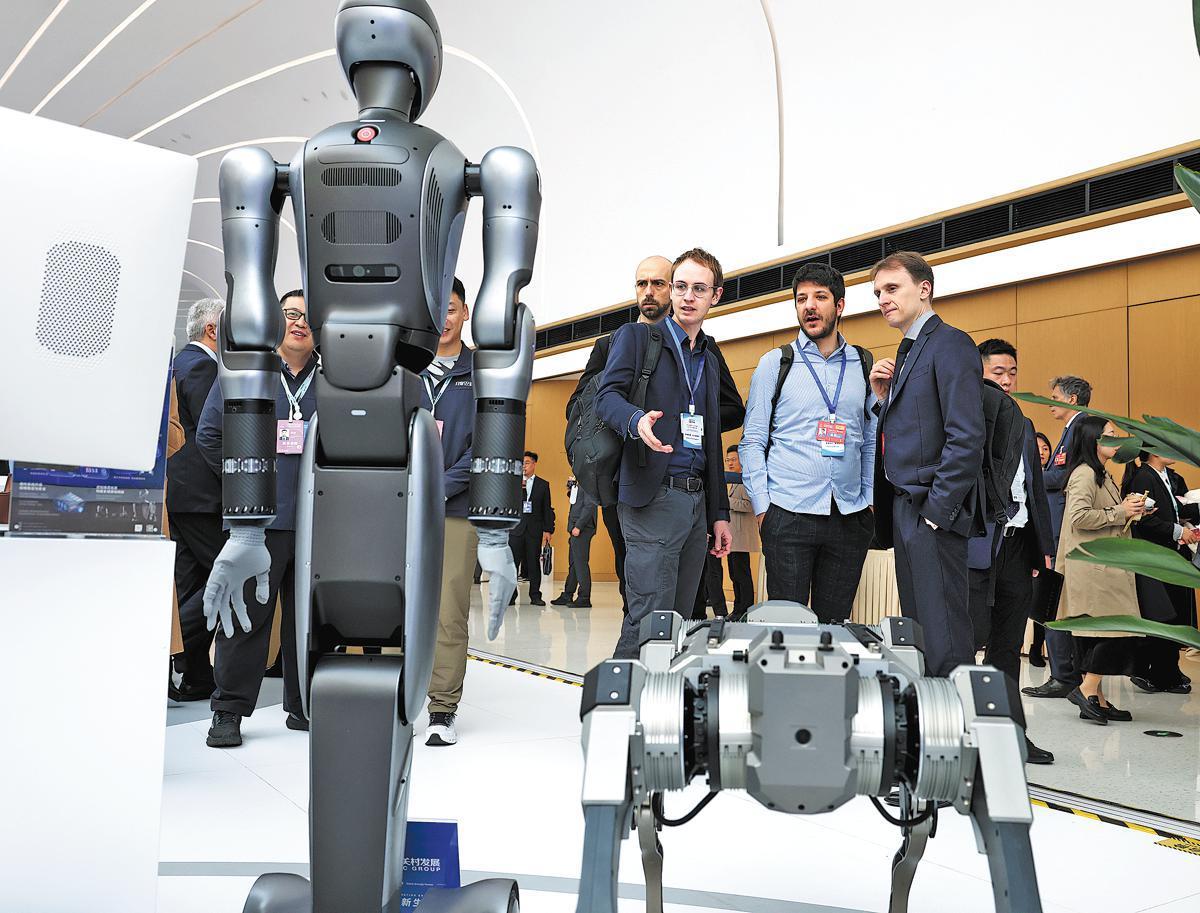
Guests view a wheeled humanoid robot (left) and 太仓快速发展新闻网a quadruped robot dog on Wednesday during the 2026 Zhongguancun Forum in Beijing. The forum, which opened on Wednesday and will run through Sunday, has attracted participants from over 100 countries and regions. ZOU HONG / CHINA DAILY
Amid intensifying geopolitical competition in high-tech sectors, China unveiled on Wednesday a plan to open some of its major scientific projects and facilities to the world, calling for the building of a "global technology community".
Speaking at the opening of the Zhongguancun Forum in Beijing, Vice-Premier Ding Xuexiang said the nation is willing to work with all parties to jointly build a "global technology community" as well as a more open and inclusive innovation network.
China will carry out broader and more diverse technological cooperation, enhancing joint efforts in fundamental and frontier research and promoting the application of emerging technologies, in order to empower the economic and social development of all countries, he said.
Ding called for countries to properly address potential regulatory conflicts, social risks and ethical challenges arising from technological development, so as to promote more equitable and responsible governance of technology.
Sergio Mujica, secretary-general of the International Organization for Standardization, said at the forum that cross-sector collaboration is essential for advancing "inclusive, sustainable and widely accessible innovation" in a rapidly changing digital world.
This year's Zhongguancun Forum, which runs through Sunday, is themed "Full Integration Between Technological and Industrial Innovation". It has attracted thousands of participants from more than 100 countries and regions, underscoring China's position as an anchor of global tech dialogue.
On the opening day, China released its action plan for international cooperation in open science, pledging to make 10 large-scale projects and facilities, including its deep-space monitoring systems, particle observatories and fusion devices, accessible to global researchers.
Among these is the Chinese Meridian Project, the only country-level facility in China dedicated to space environment monitoring. It has established the world's most extensive ground-based network for monitoring space environments, and to date, it has served 267 organizations across 18 countries, including Germany and Brazil.
China's emphasis on open collaboration, which was praised by officials and industry insiders at the forum, also signals an attempt to shape global norms around artificial intelligence development. The nation is not just rapidly expanding the scope of AI applications, it is also attempting to figure out how models can be built, shared and applied in industrial settings.
Speaking on the sidelines of the forum, Yang Zhilin, founder of Chinese artificial intelligence company Moonshot AI, said that Chinese enterprises are increasingly positioning themselves as drivers of structural change in the AI ecosystem — a shift he described as both an opportunity and a defining strategy for the nation.
"China's willingness to openly share large models and technological breakthroughs could accelerate global innovation while giving it an edge over the closed tech ecosystems of other countries," Yang said.
"In the long run, the bottleneck may no longer be model capability, but how quickly one can build large-scale 'token factories'," he said, adding that energy costs and computing infrastructure will serve as decisive factors in the new AI development stage.
A "token factory" refers to large-scale infrastructure — data centers, chips and optimized AI models — designed for maximum throughput of tokens, which are units of data processed.
Statistics from aggregation platform OpenRouter show that Chinese AI models have surpassed US ones in terms of global usage for three consecutive weeks.
Among the top 10 AI models by usage, Chinese models recorded a total of 7.359 trillion tokens last week, up 56.9 percent from the previous week, showing a further acceleration in growth. In contrast, AI models from the US recorded 3.536 trillion tokens.
Speaking at the forum, Wang Binying, deputy director-general of the World Intellectual Property Organization, said that China is the first country to surpass 5 million granted domestic invention patents, and it accounts for more than 40 percent of global generative AI patent filings.
"China's innovation track record has been remarkable," Wang added.
文章推荐: